
Rugby Jersey Manufacturer for Clubs That Have to Reorder
Jafsu Enterprises is a rugby jersey manufacturer cutting, sublimating and sewing full team rugby kits to your own pattern, badge and written spec — not a stock shirt with your crest pressed on top. Low MOQ from 20 pieces, samples from one, and every stitch, print and label done in our own building. That is what keeps February’s replacements matching August’s kit.
WhatsApp +92 347 0849427 · info@jafsuenterprises.com · every enquiry answered within 24 hours

What Does a Rugby Jersey Manufacturer Actually Do?
A rugby jersey manufacturer builds match jerseys, training tops, shorts and layers from your own pattern and chosen fabric, then sublimates, embroiders, labels and packs them under your club’s name. We do that from a single sample piece and a low MOQ of 20, shipping custom rugby kits for teams from Sialkot, Pakistan to the UK, USA, Canada, Europe and Australia.
Most rugby team kit suppliers sell a finished blank and decorate it: the body, the collar and the neck label belong to someone else. A manufacturer starts further back, at the cloth, the block and the tolerance sheet. That is the line between a decorated stock shirt and customised rugby team kits that are genuinely yours, and between printing and cut and sew production.
We work both ways. OEM means you send the tech pack and we build precisely to it, down to collar height and sponsor position. ODM means you start from one of our developed rugby blocks and we adapt fit, panels, colourway and badging around your club. New sides usually begin ODM, then move to OEM once the fit is settled.
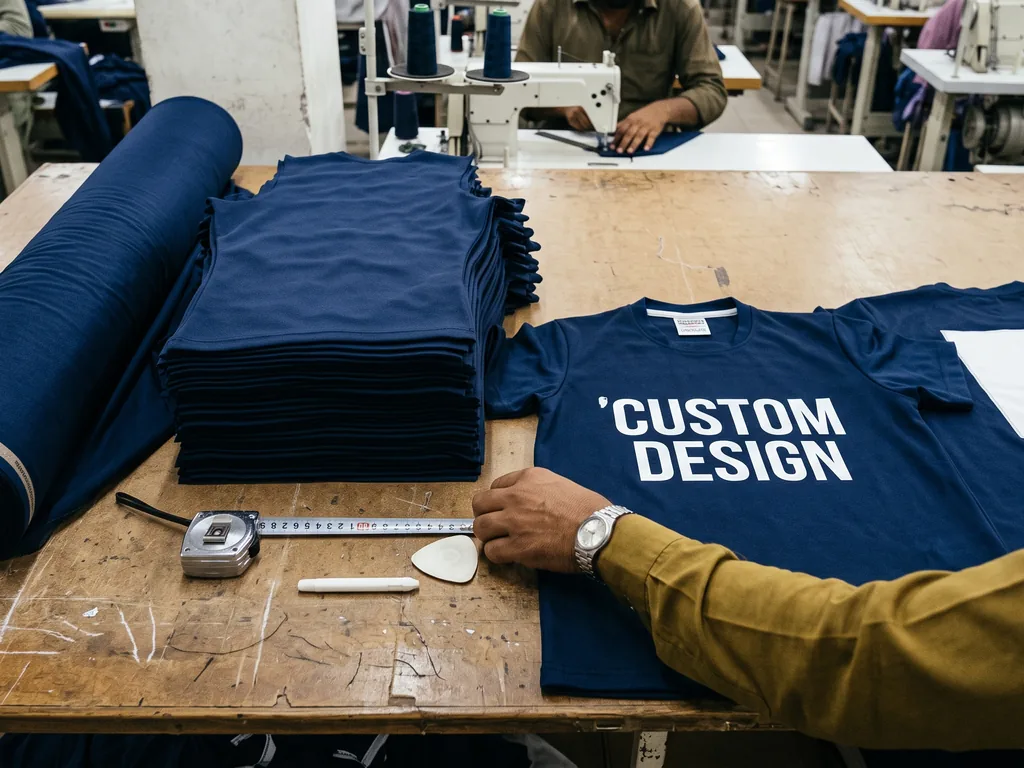
The hard question is never who makes your first 20 jerseys. It is who makes February’s eight replacements look like them. Clubs change supplier after the reorder, when the navy comes back a shade lighter or the sponsor panel sits low on half the run.
That is not bad luck. It is what happens when a rugby team kit lives in a chat thread instead of a written sheet of colour references, weights and per-size measurements. The numbers below are what that sheet should hold.
Full Team Rugby Kits, Built to Your Block
Six lines cover almost every order that leaves the floor, each cut to your measurements and fabric weight.
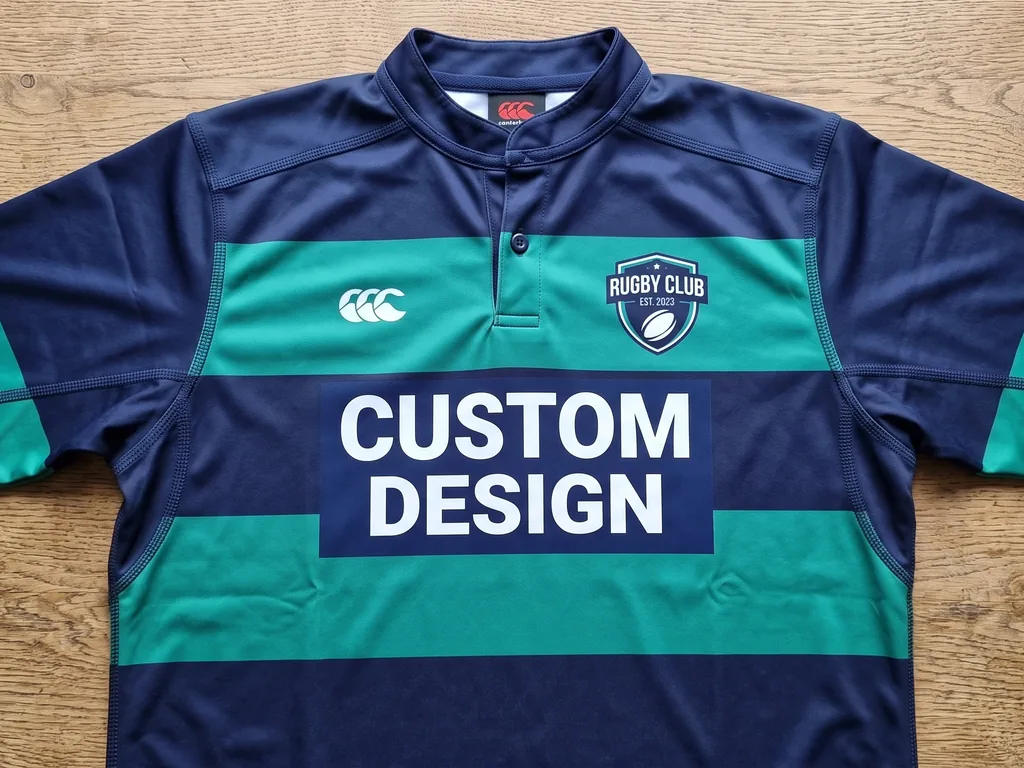
Sublimated match jerseys
Tight-knit polyester interlock with elastane, reinforced grandad or rib collars, twin-needle shoulder seams and taped stress points. As a sublimated rugby jersey manufacturer we dye hoops, numbers and sponsor panels into the cloth, so nothing cracks or peels in contact.
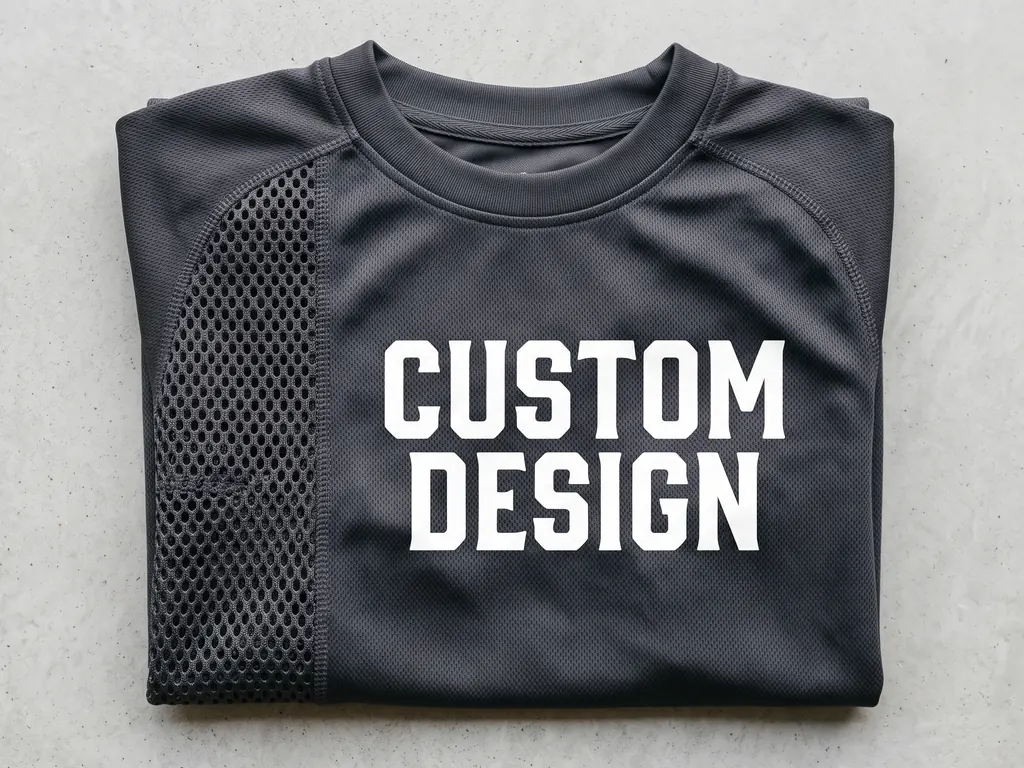
Training and warm-up tops
Micro-mesh, birdseye and poly-cotton bodies for pre-season and matchday warm-ups, with mesh panels under the arm. The training range runs off the same artwork file as the match shirt, so it reads as one kit rather than a second design.
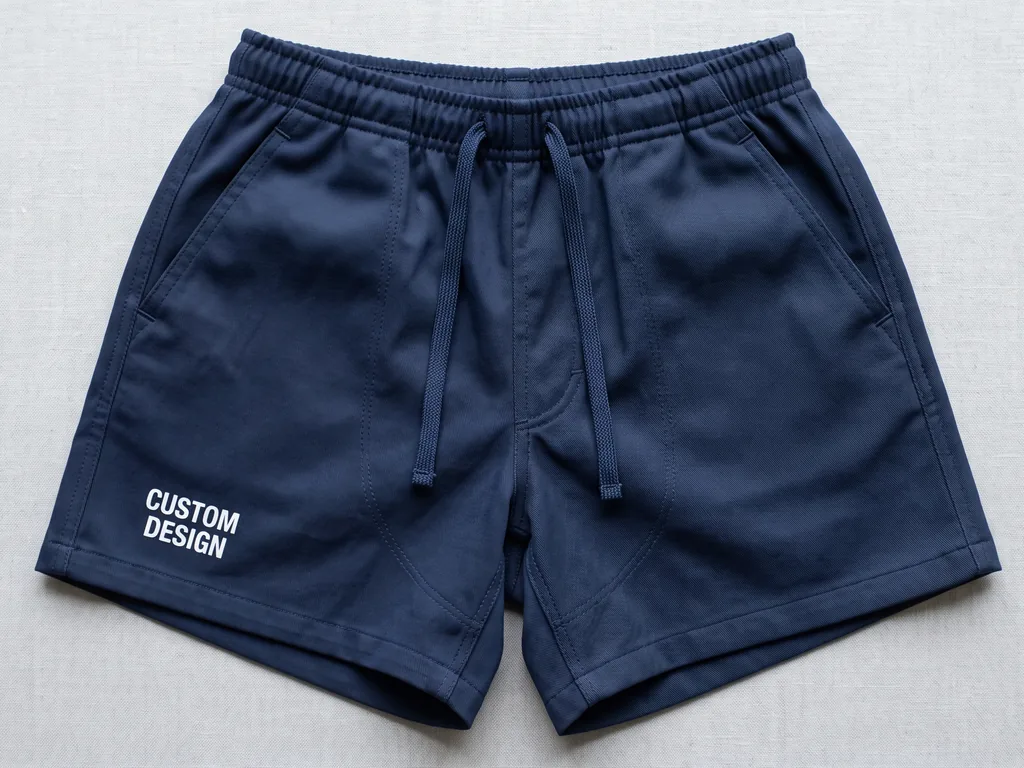
Rugby shorts
Poly twill and mechanical-stretch woven shorts with a gusseted crotch, bar-tacked pockets, elasticated waist and drawcord, in playing or training lengths. Shorts ordered with jerseys are cut from one dye lot — two lots of a navy read as a mismatch on the pitch.
Youth and minis kits
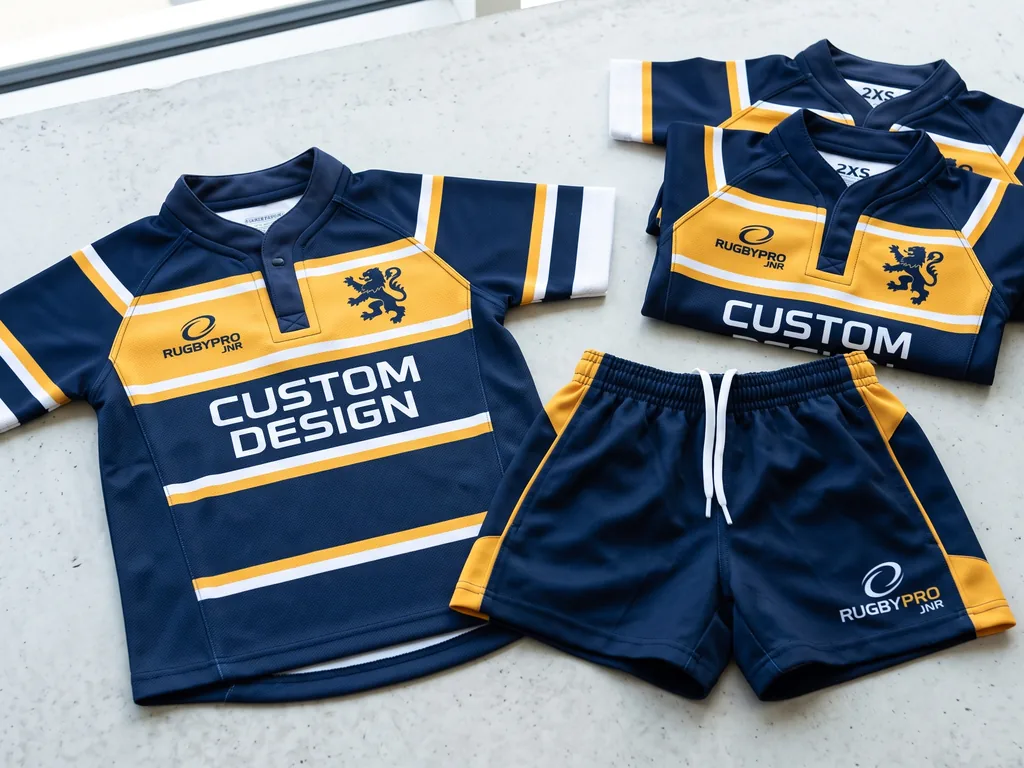
Childrens rugby team kits graded on their own youth block from YS to YXL, not shrunk from an adult pattern — a scaled senior shirt gives a small body with adult armholes. Minis and juniors run alongside the senior order on one spec.
Matchday and travel layers
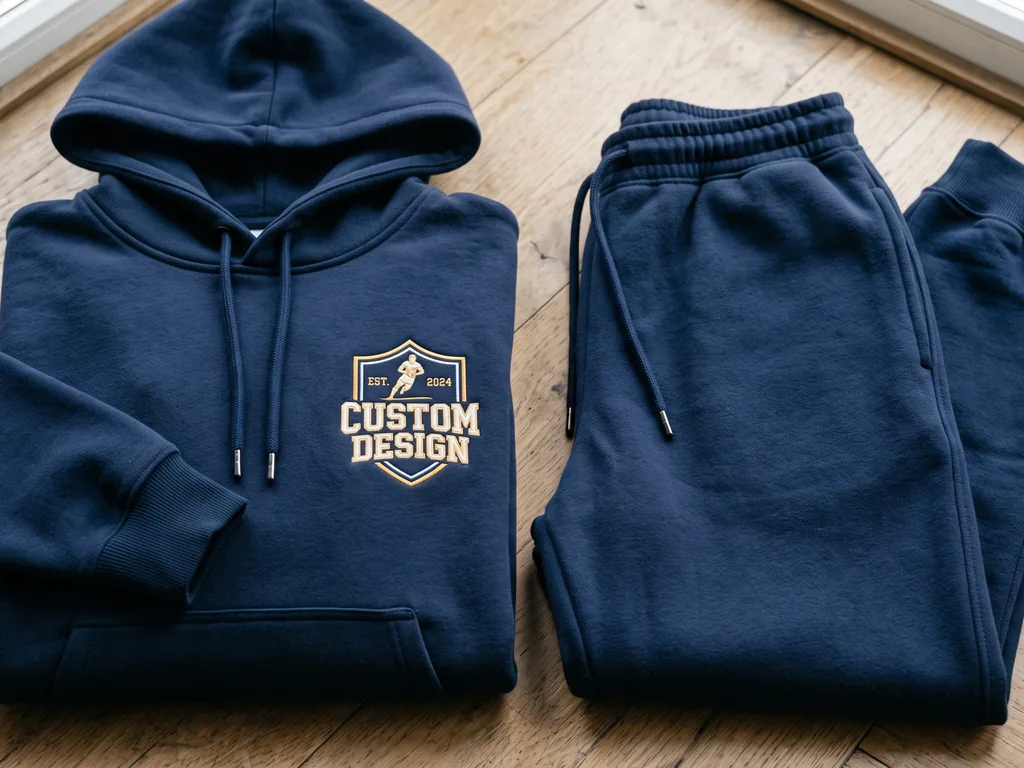
Hoodies, quarter-zips, rain jackets and tracksuits in fleece or micro-poly, cut from one dye lot with crests embroidered rather than printed. This is where full team rugby kits carry past the touchline, onto the bench and the coaching staff.
Kit bags, socks and extras
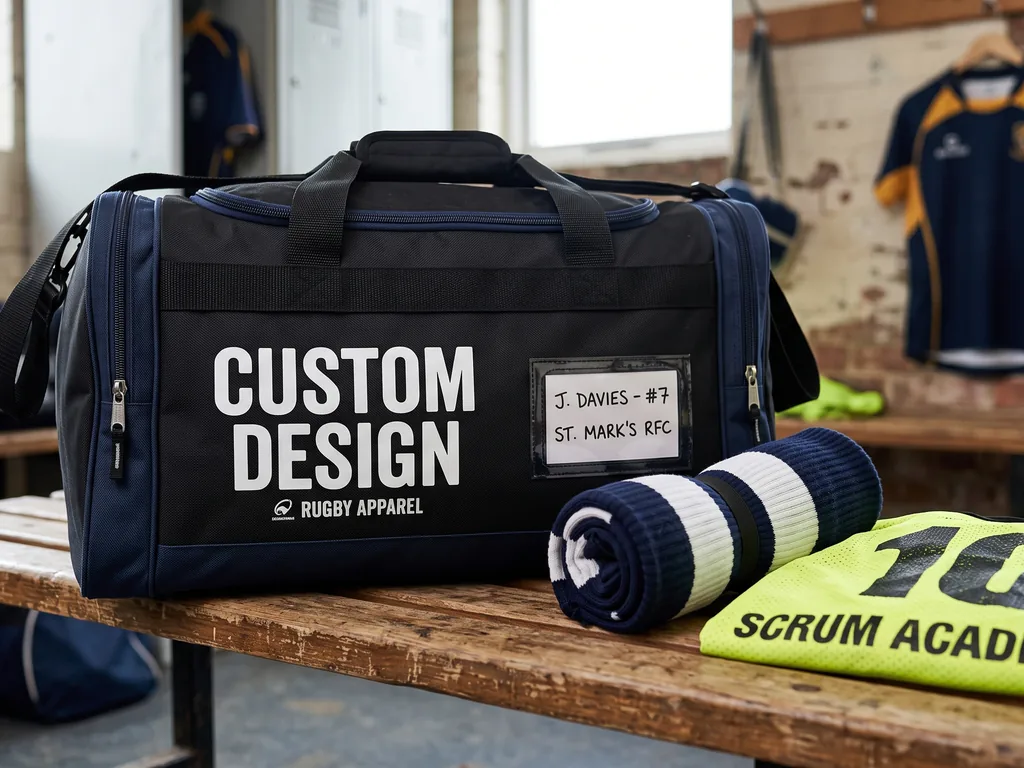
Rugby team kit bags in hard-wearing 600D polyester — holdalls, wheeled bags and backpacks with name panels — plus knitted socks in club hoops and training bibs. Adding them keeps one artwork file, one woven label spec and one shipment.
Six Lines That Decide Whether Next Season’s Kit Matches
Send these to every rugby jersey manufacturer you shortlist. The ones worth working with answer in numbers; the rest answer with adjectives.
- Fabric weight in both units. 260 GSM and 7.7 oz/yd² describe the same cloth; one conversion error separates the match jersey you costed from a training shirt.
- Knit construction, not just “polyester”. Interlock is a double knit that stays stable and opaque when a shirt is grabbed; birdseye mesh is lighter and more open, right for training tops and wrong for match day.
- Composition and recovery. The elastane percentage decides whether a pulled jersey returns to shape or stays stretched at the collar after three fixtures.
- Colour by reference, not by name. Pantone numbers or an approved lab dip, because a club navy sublimates on interlock differently from how it dyes on twill or fleece.
- Measurement tolerance per point, per size. Chest, body length and sleeve each need a written allowance across YS–YXL and S–4XL, or “close enough” is decided by whoever holds the tape.
- Numbering, badges and trims, named. Number height and font, sponsor panel size and position from the HPS, stitch count, and the exact neck label in every piece.
A manufacturer quoting against this sheet instead of a photograph can cost it in 24 to 48 hours, and the sample you approve becomes the spec that bulk is measured against.
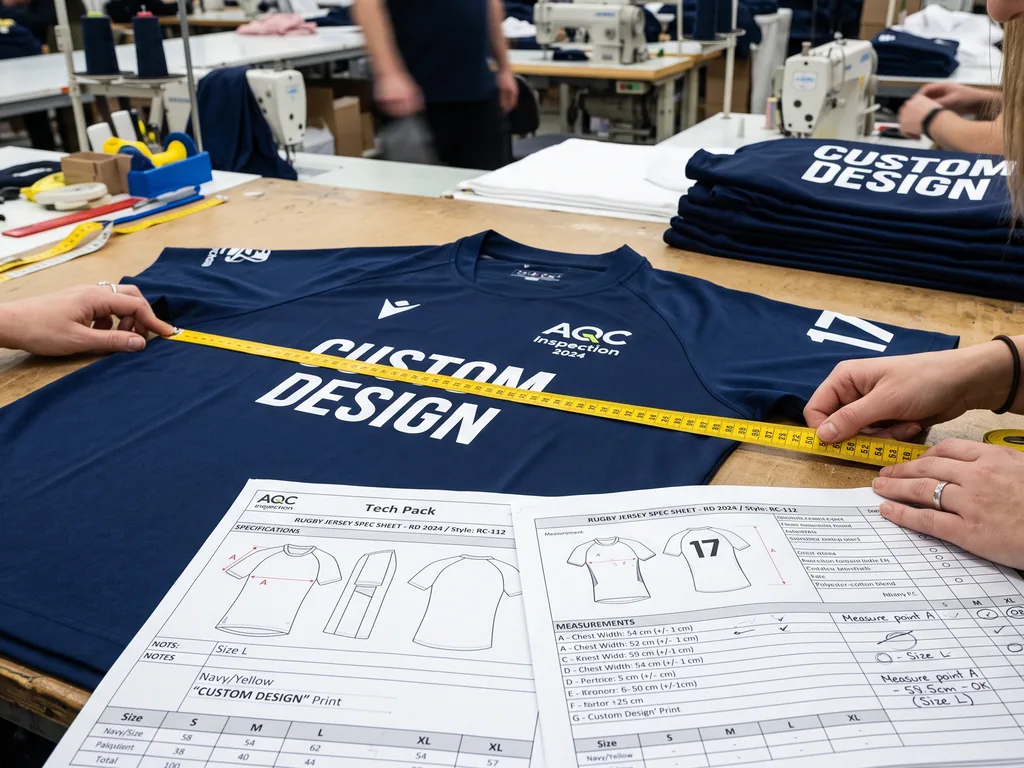
The sheet travels with the order
Cutting, stitching, sublimation, printing, embroidery, labelling and packing all happen in one building — the advantage of a rugby jersey manufacturer that brokers nothing out. Measurements checked at inspection are the ones written at quoting, and your artwork and patterns stay yours on OEM or ODM work.
Fabric Weights, Quantities and Lead Times
Every rugby jersey manufacturer should publish these in both units, because a factory quoting in GSM and a club costing in ounces are describing the same cloth. The conversion factor is 33.906.
| Garment | Fabric and construction | GSM | oz/yd² |
|---|---|---|---|
| Match jerseys | Poly interlock with elastane, tight double knit | 220–300 | 6.5–8.8 |
| Training tops | Micro-mesh, birdseye, poly-cotton | 140–220 | 4.1–6.5 |
| Rugby shorts | Poly twill or stretch woven | 180–260 | 5.3–7.7 |
| Hoodies, tracksuits | French terry or brushed fleece | 320–450+ | 9.4–13.3 |
| Socks, bibs, bags | Knitted cotton-poly, 600D polyester | On spec | On spec |
| Stage | What happens | Quantity / time |
|---|---|---|
| Mockup | Spec reviewed, badge and numbers placed, costing returned | 24–48 hrs |
| Sample | One sewn jersey for fit, colour and decoration sign-off | 1 pc · 7–10 days |
| First kit run | One design and colourway, split YS–YXL and S–4XL | 20–40 pcs |
| Bulk 50–300 pcs | Production with inline and endline inspection | 14–18 working days |
| Bulk 500–1,000+ | Volume run; breaks at 100 / 300 / 500 / 1,000+ | 20–25 working days |
| Dispatch | DHL, FedEx or UPS express, door to door | 4–6 business days |
| Payment | Samples 100% advance; bulk 50% deposit, balance before dispatch against QC photos | PayPal · Remitly · wire |
Weight converter: what does that GSM actually feel like?
Drag to see the same cloth in both units, and what that weight is usually cut into on a rugby order.
How a Team Kit Runs Through the Factory
Every order takes the same five stages, whether it is 20 jerseys or 2,000.
-
Enquiry and costing
Send a tech pack, a current jersey or a sketch with your badge, colours and squad list. Back comes a mockup and per-piece costing split by fabric, decoration and trims.
-
Pattern and spec lock
Measurements, GSM, construction, Pantone references, tolerances, numbering and sponsor placements confirmed in writing. Revisions here cost nothing; the same change after cutting costs a run and a fixture.
-
One-piece sample
One sewn jersey in your fabric, fit and colourway. Wash it, train in it, measure it against the sheet. Nothing moves to bulk until a club officer signs this piece off.
-
Production
Sublimation or screen printing, spreading, cutting, stitching and embroidery, then numbering, labelling and packing by size, with inline and endline checks.
-
QC and dispatch
QC photographs and video reach you before the balance falls due, then express dispatch with tracking and the export paperwork handled here.
Four Kinds of Buyer, One Production Line
Rugby team kit suppliers see the same four buyers. The brief changes; the line does not.
Clubs and academies
Senior, colts and veterans sides ordering home, away and training kit on one spec. A low MOQ of 20 means a club orders what the squad needs, not a pallet of spare sizes.
Schools and minis
Youth sections ordering childrens rugby team kits on a proper YS–YXL block, with names and numbers set from the squad list and packed size by size.
Teamwear distributors
Rugby team kit suppliers and stockists buying repeat bulk with price breaks at 100, 300, 500 and 1,000+ pieces, under their own neck label.
Brands on OEM or ODM
Labels developing a rugby range from a tech pack, or adapting our blocks, alongside our fitnesswear production.
Rugby Jersey Manufacturer FAQ
What is the minimum order for custom rugby kits for teams?
Samples start at one piece and bulk at 20 pieces per design and colourway, split across YS–YXL and S–4XL. Most rugby jersey manufacturers ask for 100 to 500, so a low MOQ of 20 lets one side or a new label put out a proper kit without funding unsold stock.
How do I choose between rugby team kit suppliers?
Ask everyone on your shortlist for the same six numbers: fabric weight in GSM and oz/yd², knit construction, composition, colour reference, measurement tolerance per size and exact trims. The best custom rugby jersey manufacturers for teams answer in figures; the rest answer with premium and one-stop. Then sample the two strongest replies.
Can I get a cheap rugby team kit without dropping quality?
Cost comes down through fewer SKUs, more units per design, simpler decoration and a locked spec, not thinner cloth. A cheap rugby team kit built on 150 GSM single jersey fails in the first scrum. Bulk price breaks apply at 100, 300, 500 and 1,000+ pieces, and every quote is itemised so you can see which line to adjust.
Do you make childrens rugby team kits?
Yes. Youth kit is graded on its own block in YS, YM, YL and YXL rather than scaled down from adult patterns, with softer collars and shorter bodies. Minis, juniors and senior sides run on one order, one colour reference and one delivery.
Sublimation or screen print for rugby jerseys?
For match shirts, sublimation. A sublimated rugby jersey manufacturer dyes artwork into the polyester fibre, so hoops, numbers and sponsor panels cannot crack or peel in contact, and a full-body design costs no more than a simple one. Screen print and embroidery still suit cotton tees, hoodies and crests.
Do you supply full team rugby kits and kit bags together?
Yes. Jerseys, shorts, socks, training tops, layers and rugby team kit bags run on one order against one artwork file, then packed by player name and size. Ordering together holds every colour to one reference and saves a second round of freight.
Do you work OEM or ODM?
Both. OEM means we manufacture to your tech pack exactly as drawn, with your patterns and artwork staying your property. ODM means you take one of our rugby blocks and we adapt fit, panels and badging around your club. ODM starts faster and cheaper; OEM gives you total control.
Do you supply clubs in the UK and USA, and handle reorders?
Yes. We ship door to door to the UK, USA, Canada, Europe and Australia by DHL, FedEx and UPS, usually in four to six business days. As a custom rugby jerseys manufacturer we keep your pattern and spec on file, so reorders run 14 to 18 working days for 50 to 300 pieces.
Send the Badge. Get One Jersey Back.
Itemised costing and a mockup within 24–48 hours, a sewn sample in 7–10 working days, production from 20 pieces and bulk price breaks beyond — from a rugby jersey manufacturer that answers every enquiry inside a day.
WhatsApp +92 347 0849427 · info@jafsuenterprises.com · Instagram @jafsusports · every enquiry answered within 24 hours