
What Is a Tech Pack? A Plain Guide and a Free Template
What goes into a tech pack, which parts a factory cannot work without, how to measure a garment for one, and a free template you can fill in tonight. For brands in the USA, UK, Europe and Australia getting their first garment made.
By the Jafsu Enterprises production team · Updated 2 October 2026 · 8 min read
Order terms used in this guide
What Is a Tech Pack in Clothing Manufacturing?
A tech pack is the instruction manual for a garment: the document that tells a factory exactly what to make. It holds flat sketches, a measurement chart for every size, the fabric and trims list, artwork placements, colour references and labelling. With a complete tech pack, any factory can quote, sample and produce the same garment without guessing.
Without one, the factory fills the gaps with its own defaults, and you find out which defaults it chose when the sample arrives. Each gap usually costs a sampling round.
The Eight Parts of a Tech Pack
The first five decide whether a factory can sample your garment. The last three decide whether the finished run arrives the way you pictured it.
Flat sketches
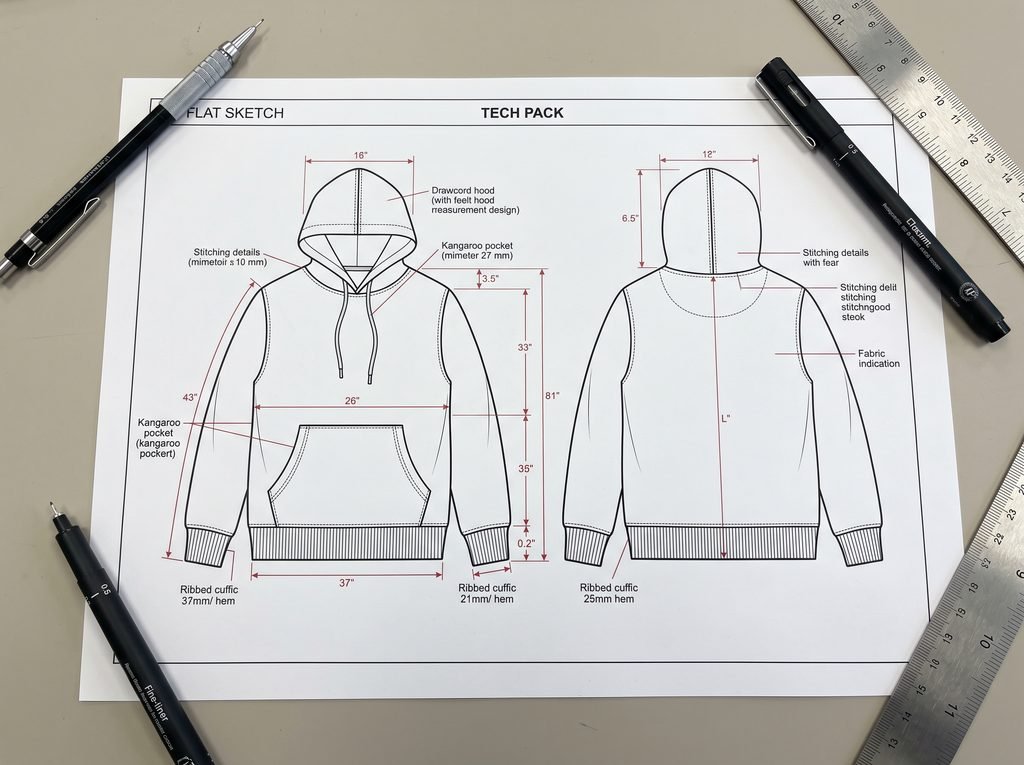
Front and back line drawings of the garment laid flat, roughly to scale, with seams, pockets and stitching shown. No shading, no model.
Measurement chart
Every point of measure for every size, a note on how each is measured, and a tolerance for how far a finished piece may vary.
Bill of materials
Body fabric with composition and weight, rib, lining, thread, drawcords, eyelets, zips and labels, each with its placement.
Artwork and placement
Vector artwork files, the method for each placement (print, embroidery, puff), finished size and position from a fixed point.
Colourways
Every colour version, with a Pantone TCX reference for each part: body, rib, drawcord and each print colour.
Construction details
Seam and stitch types where they matter: flatlock on activewear, twin-needle hems, a double-layer hood, a coverstitched cuff.
Labels and packaging
Neck label, care label, size label, swing tag, polybag and folding method, so every piece arrives retail-ready.
Size split and revisions
Pieces per size for each colourway, plus a dated log of every change so everyone works from the same version.
How to Write the Measurement Chart
The measurement chart is where most first tech packs fall short. “S to XL” is a label, not a specification: the factory needs a number for every point of measure, in every size, measured the same way every time.
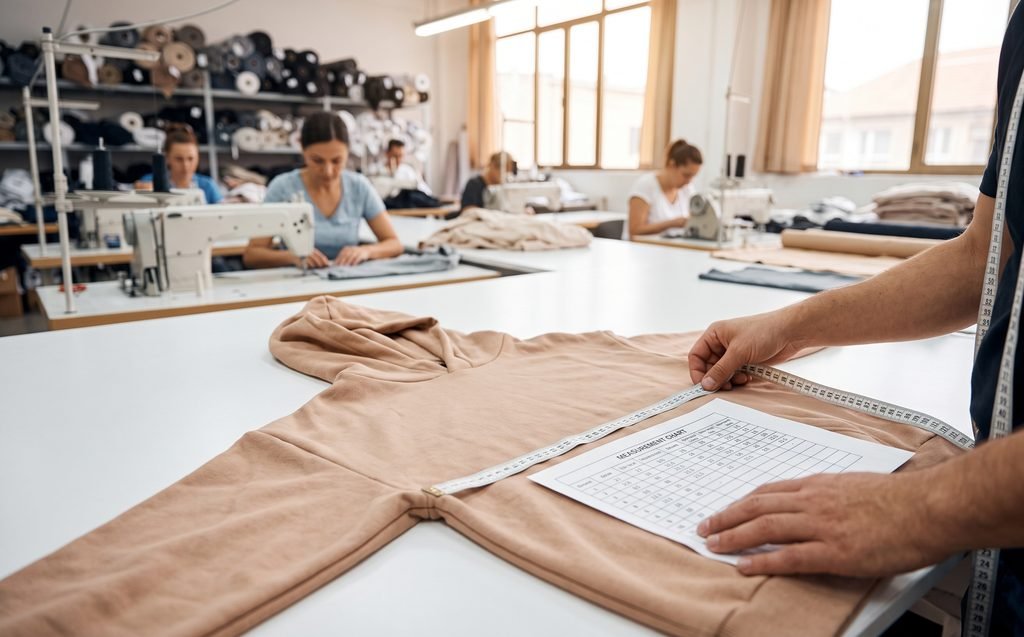
If you have no pattern yet, start with a garment whose fit you like. Lay it flat on a table, smooth it without stretching, and measure each point below. That becomes your base size. The factory grades the other sizes from it, and a grade rule records how much each measurement changes from one size to the next.
Choose centimetres or inches and use that unit everywhere. Mixing them is one of the commonest reasons a sample comes back the wrong size.
| Point of measure | How to measure it, garment laid flat |
|---|---|
| Body length | From the high point shoulder (HPS), where the shoulder seam meets the collar, straight down to the hem edge |
| Chest width | Edge to edge, 2.5 cm (1 in) below the armhole |
| Hem width | Edge to edge along the hem or rib, relaxed |
| Shoulder width | Shoulder seam to shoulder seam |
| Sleeve length | Shoulder seam to cuff edge |
| Cuff width and rib height | Edge to edge, relaxed; rib from seam to edge |
| Hood height and width | HPS to the top of the hood; edge to edge at the widest point |
The free template below already lists these points, plus neck opening, bicep width and pocket size.
Is Your Tech Pack Ready to Send?
Tick what you already have. The checker tells you whether a factory can sample from it, quote from it, or needs more first.
0 of 5 essentials · 0 of 5 extras
Start with what you have
You can still get a garment made. Send photos of a garment you like and a short list of the changes you want, or let our tech pack service write the spec for you.
We work from a full tech pack, a reference garment, photographs or a sketch with measurements. Whatever you send, the full spec is confirmed with you in writing before any fabric is cut.
Free Tech Pack Template
A spreadsheet tech pack that opens in Excel, Google Sheets or Numbers. It is built for hoodies, tees, joggers and activewear, and it is the same structure our team works from.
- Style and sketches: style details and space for front and back flats
- Measurements: hoodie points of measure, each with how to measure it
- Bill of materials: 13 components listed, from body fabric to polybag
- Artwork and placement: method, size and position for each print
- Colourways: Pantone TCX references for every part
- Labels and packaging: with a note on US, UK and EU labelling rules
- Size split and revisions: totals and a 20-piece MOQ check
How to use it
-
Fill the teal cells
Work left to right through the tabs. Grey rows are examples; overwrite or delete them.
-
Paste your flats
Drop front and back sketches into the two boxes on the first tab. Phone photos of hand drawings are fine to start.
-
Send it for a costing
Email or WhatsApp the file. Itemised costing and a mockup come back within 24–48 hours.
Five Tech Pack Mistakes That Cost a Sample Round
Fabric without a number
“Cotton fleece” covers everything from a light loopback to a 450 GSM brushed fleece. Give composition and weight.
Sizes without points of measure
A size label tells the factory nothing about chest, length or sleeve. List every measurement, for every size.
Artwork as a screenshot
Low-resolution images blur when scaled. Send vector files (AI, EPS, SVG or PDF) with the finished print size.
Colour by name
“Teal” on your screen and “teal” at the dye house are different colours. A Pantone TCX reference is the same everywhere.
No version control
Two versions of a tech pack in two inboxes produce a sample that matches neither. Date every change in one revision log.
We can write it for you
Our tech pack service turns a reference garment or sketch into a factory-ready spec.
Questions About Tech Packs
Do I need a tech pack to work with a clothing manufacturer?
Not always. A tech pack speeds up sampling and cuts revision rounds, but we can also work from reference photographs, a physical garment or a sketch with measurements. Whatever you send, the full specification is confirmed with you in writing before any fabric is cut.
What software do I need to make a tech pack?
None beyond a spreadsheet. Flat sketches are often drawn in Adobe Illustrator, but a clean hand drawing photographed flat is enough to start. The measurements, materials and placements matter more than how polished the document looks.
How detailed does a tech pack need to be for a first sample?
Cover the five essentials: flat sketches, a measurement chart for at least your base size, fabric composition and weight, artwork with size and position, and colour references. Construction, labelling and the size split can follow before bulk production.
Who owns my tech pack and designs?
You do. Your tech pack, designs, patterns and artwork remain your intellectual property, and we never reuse or resell them.
Can one tech pack cover several colourways?
Yes. Keep one tech pack per style and add a colourway page listing the Pantone reference for every part of each colour version. At Jafsu Enterprises each colourway is produced from 20 pieces.
The Rest of the Brand Launch Series
Send Your Tech Pack. Get a Costing Back.
Complete or half-finished, send what you have. Itemised costing and a mockup in 24–48 hours, a sewn sample in 7–10 working days.
info@jafsuenterprises.com · @jafsusports · Every enquiry answered within 24 hours.